

Nuclear could account for more than 10 percent of green energy bonds, says ICMA
By Anne Field , Ensia
A few years ago, the Mexican authorities pinpointed a promising method for reducing carbon dioxide emissions: Encourage Mexicans to merchandise in their erstwhile refrigerators, air conditioners, light bulbs and the like for more up-to-date models. After all, nigh 80 pct of the country's energy comes from fossil fuels, and household appliances account for about a quarter of its electricity utilise. Merely how to pay for the program, while making information technology affordable for poor households?
A financing mechanism called a green bond is a new strategy for funding investments that may lessen impacts of climatic change.
Credit: Curt Carnemark/ World Bank
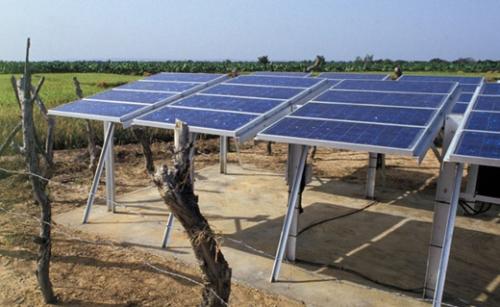
The reply: A financing machinery chosen a green bond. After implementing this new strategy for funding environmentally friendly investments, the Mexican initiative is on track to reduce CO ii emissions by more than one million tons a twelvemonth for the foreseeable future — the equivalent of cutting the carbon emissions of 217,000 cars annually, according to greenish bail pioneer World Bank, which issued the musical instrument.
In fact, the projection is simply one of scores of efforts effectually the world aimed at reducing carbon emissions or helping communities conform to climate change — initiatives that are being paid for, at least partially, by this new type of financing. By yr stop, experts expect the full corporeality invested in such bonds to hitting $twoscore billion, upwards from just $2 billion in 2012.
"Nosotros've never seen this kind of exponential jump in market size," says Mindy Lubber, president of Ceres, an environmental advocacy grouping based in Boston.
Needed: $ane Trillion per Year
Adopting environmentally friendly technologies and techniques, from wind and solar installation to watershed management, is costly — very costly. According to the International Energy Agency, we need to invest at to the lowest degree an additional $one trillion per year just into clean energy projects worldwide past 2050 to ensure that global warming is limited to 2 degrees Celsius, fugitive the virtually catastrophic effects of climate change.
"The focus is on allowing the states to transition to a low-carbon economic system — and to exercise it quickly," says Sean Kidney, CEO and co-founder of the Climate Bonds Initiative, a London-based nonprofit.
Tapping a long-established financing machinery — bonds — is a way to boost the chances investors, from alimony funds to nugget managers, volition get involved. "Investors like vehicles they're comfortable with," says Lubber. "If nosotros tried something completely new, it would be harder."
Projects funded by greenish bonds are located throughout the world and focus on a variety of goals, from increasing the resiliency of water systems to boosting free energy efficiency.
Projects funded by green bonds are located throughout the earth and focus on a variety of goals, from increasing the resiliency of h2o systems to boosting energy efficiency.The first issuers were evolution banks, such as the World Bank and the European Bank for Reconstruction and Development, which got the ball rolling in 2007. More recently, a flood of banks, utilities and government agencies, among others, accept started issuing green bonds. While the bonds can be used for whatever environmentally friendly effort — think cleaning up a polluted river — many are aimed at addressing the impacts of climate change. Some are issued for specific projects. Others, called "ring fencing," prepare aside coin for green initiatives without specifying the program; the proceeds are invested only in eligible green projects.
Projects funded by green bonds are located throughout the earth and focus on a multifariousness of goals, from increasing the resiliency of water systems to boosting energy efficiency. In addition to the Mexican government's appliance trade-in programme, for instance, Globe Banking company-issued bonds are helping to support efforts in Tunisia to develop better irrigation systems to salve h2o and a plan in Montenegro to upgrade windows, lighting and insulation in public schools and hospitals, among other projects.
The Push button for Standards
Still, like any market place in its infancy, green bonds confront a host of stumbling blocks. One is the chance posed by irresolute government policies. "These projects can be circuitous," says Nicholas Pfaff, a manager of market exercise and regulatory policy at the International Capital Marketplace Clan in London. Pfaff offers the post-obit example: Say the financing for a project to develop solar console farms in southern Europe is based on a specific tariff level. Only so a new government comes into part and overhauls the rate, in the process decimating the underpinnings of the effort's financing assumptions. The solution, according to Pfaff, is to guarantee that, if a particular project were to go untenable, then an equivalent project would exist substituted.
Advocates say such standards are essential for boosting investor confidence and for connected growth of the market.
Advocates say such standards are essential for boosting investor confidence and for continued growth of the market.More important, as the number of players in the light-green bond market has increased, and then has the need for standardization. For example, no systematic set of criteria exists for defining simply what a greenish bond is and how to mensurate its environmental effectiveness. And there isn't a set up mechanism for third political party credit quality verification.
Advocates say such standards are essential for boosting investor confidence and for continued growth of the market place. Without them there's the chance of issuers using the light-green characterization as nothing more than a marketing ploy. "The market place would lose credibility very quickly in that case," says Michael Wilkins, managing manager in the London-based Infrastructure Finance Ratings group of Standard & Poor's Ratings Services.
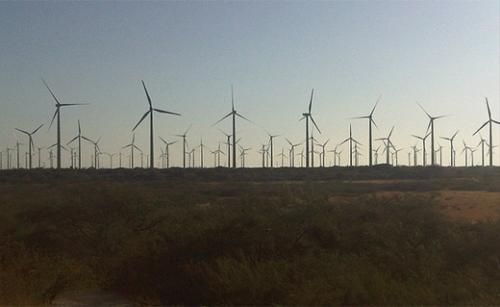
Projects funded past light-green bonds are located throughout the world and focus on a diversity of goals, from increasing the resiliency of water systems to boosting energy efficiency. Credit: IFC Infrastructure /flickr
In Jan 2014 a grouping of leading banks took preliminary steps to create standardization in the market past issuing something called Green Bond Principles. These voluntary guidelines, formed past a consortium of banks including JP Morgan Hunt, Citi, Bank of America, Merrill Lynch and Crédit Agricole Corporate and Investment Bank, include such matters as reporting requirements and the use and management of bond proceeds. Thirteen banks subscribed to the principles before long afterward they were established; today at least 55 organizations take signed on, and a group of 18 institutions is working on refining the principles. That update should be set by the outset quarter of side by side year, co-ordinate to Pfaff.
That can only be good news for the future of green bonds. Says Ceres' Lubber: "As standards get stronger, we'll see more growth in the marketplace."
Reprinted from Ensia with permission.
Source: https://www.climatecentral.org/news/green-bonds-mitigate-climate-change-18480
Posted by: minkgessarcidigh.blogspot.com
0 Response to "Nuclear could account for more than 10 percent of green energy bonds, says ICMA"
Post a Comment