

How To Create A Stack In C
Stack is a linear data structure that follows a particular order in which the operations are performed. The order may be LIFO(Last In First Out) or FILO(First In Last Out).
Mainly the following three basic operations are performed in the stack:
Attention reader! Don't stop learning now. Get hold of all the important DSA concepts with the DSA Self Paced Course at a student-friendly price and become industry ready. To complete your preparation from learning a language to DS Algo and many more, please refer Complete Interview Preparation Course .
In case you wish to attend live classes with experts, please refer DSA Live Classes for Working Professionals and Competitive Programming Live for Students.
- Push: Adds an item in the stack. If the stack is full, then it is said to be an Overflow condition.
- Pop: Removes an item from the stack. The items are popped in the reversed order in which they are pushed. If the stack is empty, then it is said to be an Underflow condition.
- Peek or Top: Returns the top element of the stack.
- isEmpty: Returns true if the stack is empty, else false.
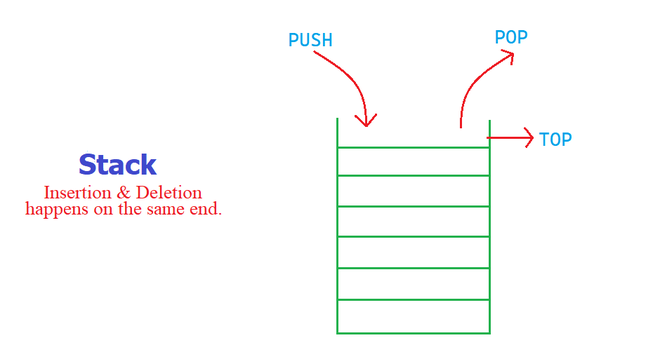
How to understand a stack practically?
There are many real-life examples of a stack. Consider the simple example of plates stacked over one another in a canteen. The plate which is at the top is the first one to be removed, i.e. the plate which has been placed at the bottommost position remains in the stack for the longest period of time. So, it can be simply seen to follow the LIFO/FILO order.
Time Complexities of operations on stack:
push(), pop(), isEmpty() and peek() all take O(1) time. We do not run any loop in any of these operations.
Applications of stack:
- Balancing of symbols
- Infix to Postfix /Prefix conversion
- Redo-undo features at many places like editors, photoshop.
- Forward and backward feature in web browsers
- Used in many algorithms like Tower of Hanoi, tree traversals, stock span problem, histogram problem.
- Backtracking is one of the algorithm designing techniques. Some examples of backtracking are the Knight-Tour problem, N-Queen problem, find your way through a maze, and game-like chess or checkers in all these problems we dive into someway if that way is not efficient we come back to the previous state and go into some another path. To get back from a current state we need to store the previous state for that purpose we need a stack.
- In Graph Algorithms like Topological Sorting and Strongly Connected Components
- In Memory management, any modern computer uses a stack as the primary management for a running purpose. Each program that is running in a computer system has its own memory allocations
- String reversal is also another application of stack. Here one by one each character gets inserted into the stack. So the first character of the string is on the bottom of the stack and the last element of a string is on the top of the stack. After Performing the pop operations on the stack we get a string in reverse order.
Implementation:
There are two ways to implement a stack:
- Using array
- Using linked list
Implementing Stack using Arrays
C++
#include <bits/stdc++.h>
using namespace std;
#define MAX 1000
class Stack {
int top;
public :
int a[MAX];
Stack() { top = -1; }
bool push( int x);
int pop();
int peek();
bool isEmpty();
};
bool Stack::push( int x)
{
if (top >= (MAX - 1)) {
cout << "Stack Overflow" ;
return false ;
}
else {
a[++top] = x;
cout << x << " pushed into stack\n" ;
return true ;
}
}
int Stack::pop()
{
if (top < 0) {
cout << "Stack Underflow" ;
return 0;
}
else {
int x = a[top--];
return x;
}
}
int Stack::peek()
{
if (top < 0) {
cout << "Stack is Empty" ;
return 0;
}
else {
int x = a[top];
return x;
}
}
bool Stack::isEmpty()
{
return (top < 0);
}
int main()
{
class Stack s;
s.push(10);
s.push(20);
s.push(30);
cout << s.pop() << " Popped from stack\n" ;
cout<< "Elements present in stack : " ;
while (!s.isEmpty())
{
cout<<s.peek()<< " " ;
s.pop();
}
return 0;
}
C
#include <limits.h>
#include <stdio.h>
#include <stdlib.h>
struct Stack {
int top;
unsigned capacity;
int * array;
};
struct Stack* createStack(unsigned capacity)
{
struct Stack* stack = ( struct Stack*) malloc ( sizeof ( struct Stack));
stack->capacity = capacity;
stack->top = -1;
stack->array = ( int *) malloc (stack->capacity * sizeof ( int ));
return stack;
}
int isFull( struct Stack* stack)
{
return stack->top == stack->capacity - 1;
}
int isEmpty( struct Stack* stack)
{
return stack->top == -1;
}
void push( struct Stack* stack, int item)
{
if (isFull(stack))
return ;
stack->array[++stack->top] = item;
printf ( "%d pushed to stack\n" , item);
}
int pop( struct Stack* stack)
{
if (isEmpty(stack))
return INT_MIN;
return stack->array[stack->top--];
}
int peek( struct Stack* stack)
{
if (isEmpty(stack))
return INT_MIN;
return stack->array[stack->top];
}
int main()
{
struct Stack* stack = createStack(100);
push(stack, 10);
push(stack, 20);
push(stack, 30);
printf ( "%d popped from stack\n" , pop(stack));
return 0;
}
Java
class Stack {
static final int MAX = 1000 ;
int top;
int a[] = new int [MAX];
boolean isEmpty()
{
return (top < 0 );
}
Stack()
{
top = - 1 ;
}
boolean push( int x)
{
if (top >= (MAX - 1 )) {
System.out.println( "Stack Overflow" );
return false ;
}
else {
a[++top] = x;
System.out.println(x + " pushed into stack" );
return true ;
}
}
int pop()
{
if (top < 0 ) {
System.out.println( "Stack Underflow" );
return 0 ;
}
else {
int x = a[top--];
return x;
}
}
int peek()
{
if (top < 0 ) {
System.out.println( "Stack Underflow" );
return 0 ;
}
else {
int x = a[top];
return x;
}
}
void print(){
for ( int i = top;i>- 1 ;i--){
System.out.print( " " + a[i]);
}
}
}
class Main {
public static void main(String args[])
{
Stack s = new Stack();
s.push( 10 );
s.push( 20 );
s.push( 30 );
System.out.println(s.pop() + " Popped from stack" );
System.out.println( "Top element is :" + s.peek());
System.out.print( "Elements present in stack :" );
s.print();
}
}
Python
from sys import maxsize
def createStack():
stack = []
return stack
def isEmpty(stack):
return len (stack) = = 0
def push(stack, item):
stack.append(item)
print (item + " pushed to stack " )
def pop(stack):
if (isEmpty(stack)):
return str ( - maxsize - 1 )
return stack.pop()
def peek(stack):
if (isEmpty(stack)):
return str ( - maxsize - 1 )
return stack[ len (stack) - 1 ]
stack = createStack()
push(stack, str ( 10 ))
push(stack, str ( 20 ))
push(stack, str ( 30 ))
print (pop(stack) + " popped from stack" )
C#
using System;
namespace ImplementStack {
class Stack {
private int [] ele;
private int top;
private int max;
public Stack( int size)
{
ele = new int [size];
top = -1;
max = size;
}
public void push( int item)
{
if (top == max - 1) {
Console.WriteLine( "Stack Overflow" );
return ;
}
else {
ele[++top] = item;
}
}
public int pop()
{
if (top == -1) {
Console.WriteLine( "Stack is Empty" );
return -1;
}
else {
Console.WriteLine( "{0} popped from stack " , ele[top]);
return ele[top--];
}
}
public int peek()
{
if (top == -1) {
Console.WriteLine( "Stack is Empty" );
return -1;
}
else {
Console.WriteLine( "{0} popped from stack " , ele[top]);
return ele[top];
}
}
public void printStack()
{
if (top == -1) {
Console.WriteLine( "Stack is Empty" );
return ;
}
else {
for ( int i = 0; i <= top; i++) {
Console.WriteLine( "{0} pushed into stack" , ele[i]);
}
}
}
}
class Program {
static void Main()
{
Stack p = new Stack(5);
p.push(10);
p.push(20);
p.push(30);
p.printStack();
p.pop();
}
}
}
Output :
10 pushed into stack 20 pushed into stack 30 pushed into stack 30 Popped from stack Top element is : 20 Elements present in stack : 20 10
Pros: Easy to implement. Memory is saved as pointers are not involved.
Cons: It is not dynamic. It doesn't grow and shrink depending on needs at runtime.
Implementing Stack using Linked List:
C++
#include <bits/stdc++.h>
using namespace std;
class StackNode {
public :
int data;
StackNode* next;
};
StackNode* newNode( int data)
{
StackNode* stackNode = new StackNode();
stackNode->data = data;
stackNode->next = NULL;
return stackNode;
}
int isEmpty(StackNode* root)
{
return !root;
}
void push(StackNode** root, int data)
{
StackNode* stackNode = newNode(data);
stackNode->next = *root;
*root = stackNode;
cout << data << " pushed to stack\n" ;
}
int pop(StackNode** root)
{
if (isEmpty(*root))
return INT_MIN;
StackNode* temp = *root;
*root = (*root)->next;
int popped = temp->data;
free (temp);
return popped;
}
int peek(StackNode* root)
{
if (isEmpty(root))
return INT_MIN;
return root->data;
}
int main()
{
StackNode* root = NULL;
push(&root, 10);
push(&root, 20);
push(&root, 30);
cout << pop(&root) << " popped from stack\n" ;
cout << "Top element is " << peek(root) << endl;
cout<< "Elements present in stack : " ;
while (!isEmpty(root))
{
cout<<peek(root)<< " " ;
pop(&root);
}
return 0;
}
C
#include <limits.h>
#include <stdio.h>
#include <stdlib.h>
struct StackNode {
int data;
struct StackNode* next;
};
struct StackNode* newNode( int data)
{
struct StackNode* stackNode =
( struct StackNode*)
malloc ( sizeof ( struct StackNode));
stackNode->data = data;
stackNode->next = NULL;
return stackNode;
}
int isEmpty( struct StackNode* root)
{
return !root;
}
void push( struct StackNode** root, int data)
{
struct StackNode* stackNode = newNode(data);
stackNode->next = *root;
*root = stackNode;
printf ( "%d pushed to stack\n" , data);
}
int pop( struct StackNode** root)
{
if (isEmpty(*root))
return INT_MIN;
struct StackNode* temp = *root;
*root = (*root)->next;
int popped = temp->data;
free (temp);
return popped;
}
int peek( struct StackNode* root)
{
if (isEmpty(root))
return INT_MIN;
return root->data;
}
int main()
{
struct StackNode* root = NULL;
push(&root, 10);
push(&root, 20);
push(&root, 30);
printf ( "%d popped from stack\n" , pop(&root));
printf ( "Top element is %d\n" , peek(root));
return 0;
}
Java
public class StackAsLinkedList {
StackNode root;
static class StackNode {
int data;
StackNode next;
StackNode( int data) { this .data = data; }
}
public boolean isEmpty()
{
if (root == null ) {
return true ;
}
else
return false ;
}
public void push( int data)
{
StackNode newNode = new StackNode(data);
if (root == null ) {
root = newNode;
}
else {
StackNode temp = root;
root = newNode;
newNode.next = temp;
}
System.out.println(data + " pushed to stack" );
}
public int pop()
{
int popped = Integer.MIN_VALUE;
if (root == null ) {
System.out.println( "Stack is Empty" );
}
else {
popped = root.data;
root = root.next;
}
return popped;
}
public int peek()
{
if (root == null ) {
System.out.println( "Stack is empty" );
return Integer.MIN_VALUE;
}
else {
return root.data;
}
}
public static void main(String[] args)
{
StackAsLinkedList sll = new StackAsLinkedList();
sll.push( 10 );
sll.push( 20 );
sll.push( 30 );
System.out.println(sll.pop()
+ " popped from stack" );
System.out.println( "Top element is " + sll.peek());
}
}
Python
class StackNode:
def __init__( self , data):
self .data = data
self . next = None
class Stack:
def __init__( self ):
self .root = None
def isEmpty( self ):
return True if self .root is None else False
def push( self , data):
newNode = StackNode(data)
newNode. next = self .root
self .root = newNode
print "% d pushed to stack" % (data)
def pop( self ):
if ( self .isEmpty()):
return float ( "-inf" )
temp = self .root
self .root = self .root. next
popped = temp.data
return popped
def peek( self ):
if self .isEmpty():
return float ( "-inf" )
return self .root.data
stack = Stack()
stack.push( 10 )
stack.push( 20 )
stack.push( 30 )
print "% d popped from stack" % (stack.pop())
print "Top element is % d " % (stack.peek())
C#
using System;
public class StackAsLinkedList {
StackNode root;
public class StackNode {
public int data;
public StackNode next;
public StackNode( int data) { this .data = data; }
}
public bool isEmpty()
{
if (root == null ) {
return true ;
}
else
return false ;
}
public void push( int data)
{
StackNode newNode = new StackNode(data);
if (root == null ) {
root = newNode;
}
else {
StackNode temp = root;
root = newNode;
newNode.next = temp;
}
Console.WriteLine(data + " pushed to stack" );
}
public int pop()
{
int popped = int .MinValue;
if (root == null ) {
Console.WriteLine( "Stack is Empty" );
}
else {
popped = root.data;
root = root.next;
}
return popped;
}
public int peek()
{
if (root == null ) {
Console.WriteLine( "Stack is empty" );
return int .MinValue;
}
else {
return root.data;
}
}
public static void Main(String[] args)
{
StackAsLinkedList sll = new StackAsLinkedList();
sll.push(10);
sll.push(20);
sll.push(30);
Console.WriteLine(sll.pop() + " popped from stack" );
Console.WriteLine( "Top element is " + sll.peek());
}
}
Output:
10 pushed to stack 20 pushed to stack 30 pushed to stack 30 popped from stack Top element is 20 Elements present in stack : 20 10
Pros: The linked list implementation of a stack can grow and shrink according to the needs at runtime.
Cons: Requires extra memory due to involvement of pointers.
https://youtu.be/vZEuSFXSMDI
We will cover the implementation of applications of the stack in separate posts.
Stack Set -2 (Infix to Postfix)
Quiz: Stack Questions
References:
http://en.wikipedia.org/wiki/Stack_%28abstract_data_type%29#Problem_Description
Please write comments if you find anything incorrect, or you want to share more information about the topic discussed above.
How To Create A Stack In C
Source: https://www.geeksforgeeks.org/stack-data-structure-introduction-program/
Posted by: minkgessarcidigh.blogspot.com
0 Response to "How To Create A Stack In C"
Post a Comment