

What Two Types Of Cell Populations Makeup Neural Tissue
Nerve Tissue
Although the nervous organization is very complex, there are only two chief types of cells in nerve tissue. The actual nerve cell is the neuron. It is the "conducting" jail cell that transmits impulses and the structural unit of the nervous organisation. The other type of jail cell is neuroglia, or glial, cell. The word "neuroglia" means "nervus glue." These cells are nonconductive and provide a support system for the neurons. They are a special type of "connective tissue" for the nervous system.
Neurons
Neurons, or nerve cells, carry out the functions of the nervous system by conducting nerve impulses. They are highly specialized and amitotic. This means that if a neuron is destroyed, it cannot be replaced because neurons do not go through mitosis. The image beneath illustrates the structure of a typical neuron.
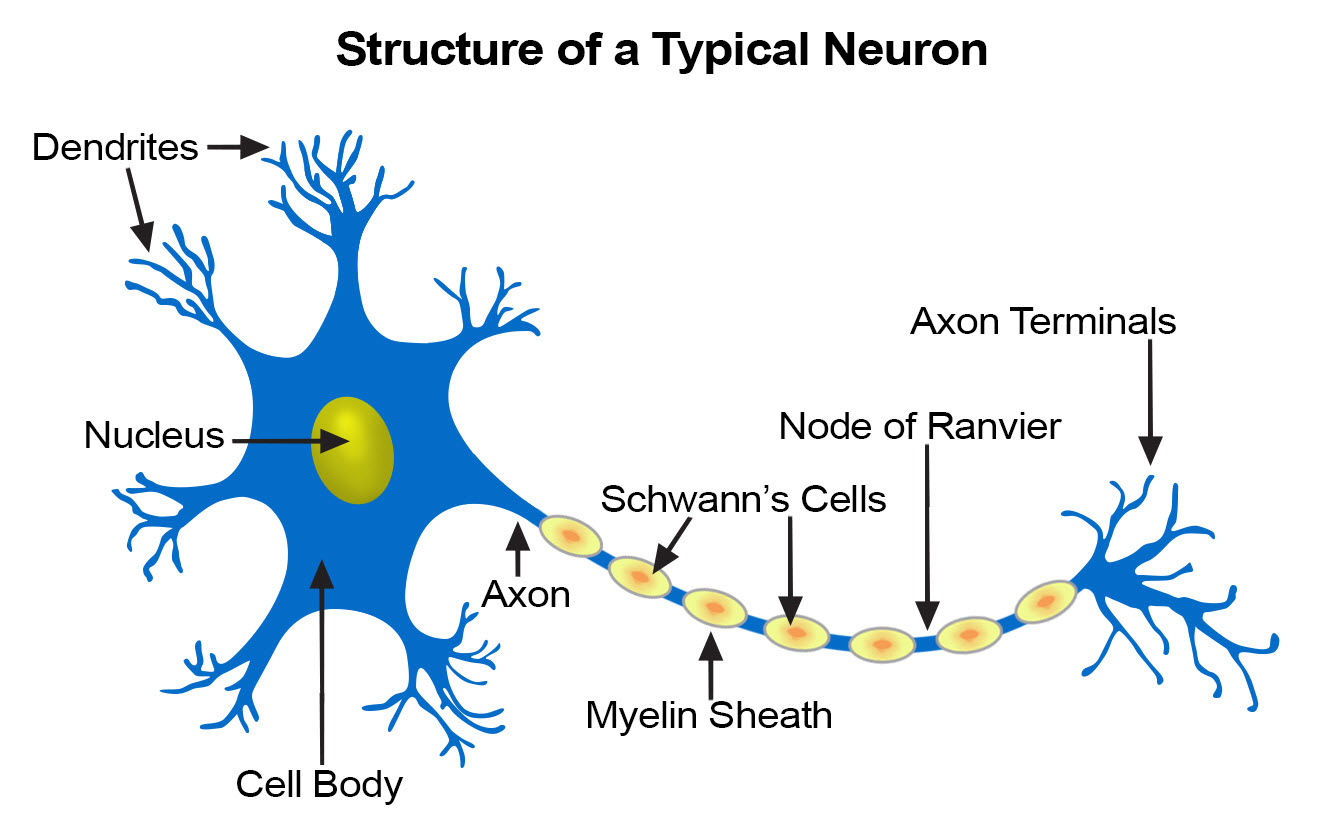
Each neuron has three basic parts: cell torso (soma), one or more dendrites, and a single axon.
Cell Body
In many ways, the prison cell body is like to other types of cells. Information technology has a nucleus with at least one nucleolus and contains many of the typical cytoplasmic organelles. It lacks centrioles, however. Because centrioles function in cell division, the fact that neurons lack these organelles is consistent with the amitotic nature of the cell.
Dendrites
Dendrites and axons are cytoplasmic extensions, or processes, that project from the prison cell torso. They are sometimes referred to as fibers. Dendrites are normally, but not ever, short and branching, which increases their surface area to receive signals from other neurons. The number of dendrites on a neuron varies. They are called afferent processes because they transmit impulses to the neuron cell body. There is only one axon that projects from each cell torso. It is ordinarily elongated and considering it carries impulses abroad from the cell trunk, it is called an efferent process.
Axon
An axon may take infrequent branches called axon collaterals. Axons and axon collaterals terminate in many brusque branches or telodendria. The distal ends of the telodendria are slightly enlarged to form synaptic bulbs. Many axons are surrounded past a segmented, white, fatty substance called myelin or the myelin sheath. Myelinated fibers make upwardly the white thing in the CNS, while jail cell bodies and unmyelinated fibers make the grey affair. The unmyelinated regions between the myelin segments are chosen the nodes of Ranvier.
In the peripheral nervous system, the myelin is produced by Schwann cells. The cytoplasm, nucleus, and outer jail cell membrane of the Schwann cell course a tight roofing around the myelin and around the axon itself at the nodes of Ranvier. This covering is the neurilemma, which plays an of import office in the regeneration of nerve fibers. In the CNS, oligodendrocytes produce myelin, but in that location is no neurilemma, which is why fibers within the CNS do not regenerate.
Functionally, neurons are classified as afferent, efferent, or interneurons (association neurons) according to the direction in which they transmit impulses relative to the central nervous organisation. Afferent, or sensory, neurons comport impulses from peripheral sense receptors to the CNS. They ordinarily have long dendrites and relatively curt axons. Efferent, or motor, neurons transmit impulses from the CNS to effector organs such as muscles and glands. Efferent neurons ordinarily accept short dendrites and long axons. Interneurons, or association neurons, are located entirely inside the CNS in which they class the connecting link between the afferent and efferent neurons. They have short dendrites and may have either a brusque or long axon.
Neuroglia
Neuroglia cells do non conduct nerve impulses, but instead, they support, attend, and protect the neurons. They are far more numerous than neurons and, unlike neurons, are capable of mitosis.
Tumors
Schwannomas are benign tumors of the peripheral nervous organization which commonly occur in their desultory, alone form in otherwise normal individuals. Rarely, individuals develop multiple schwannomas arising from ane or many elements of the peripheral nervous system.
Commonly called a Morton's Neuroma, this problem is a fairly common benign nervus growth and begins when the outer coating of a nervus in your foot thickens. This thickening is caused by irritation of branches of the medial and lateral plantar fretfulness that results when two bones repeatedly rub together.
Source: https://training.seer.cancer.gov/anatomy/nervous/tissue.html
Posted by: minkgessarcidigh.blogspot.com
0 Response to "What Two Types Of Cell Populations Makeup Neural Tissue"
Post a Comment