

How Has The Makeup Of The Population Changed Since 1943
| Demographics of Lebanon | |
|---|---|
 Lebanon population pyramid in 2020 | |
| Population | 5,469,612 (July 2020 est.),[i] including 910,256 Syrians, 470,000 Palestinians, and 5,700 Iraqis (110th) |
| Growth rate | -6.68 (2020 est.) |
| Birth rate | xiii.half dozen births/one,000 population (2020 est.) |
| Death rate | v.4 deaths/1,000 population (2020 est.) |
| Life expectancy | 78.3 years (2020 est.) |
| • male | 76.nine years (2020 est.) |
| • female person | 79.viii years (2020 est.) |
| Fertility rate | 1.72 children born/woman (SRS 2015) |
| Infant bloodshed rate | half-dozen.8 deaths/one,000 alive births (2020 est.) |
| Age structure | |
| 0–fourteen years | 23.32% (male 728,025/female 694,453) (2018 est.) |
| 15–64 years | 69.65% (male 2,139,885/female 2,108,917) (2018 est.) |
| 65 and over | seven.03% (male 185,780/female 243,015) (2018 est.) |
| Sexual practice ratio | |
| At birth | 1.05 male(southward)/female person (2017 est.) |
| Under fifteen | i.05 male(due south)/female person (2017 est.) |
| xv–64 years | i.03 male(s)/female (2014 est.) |
| 65 and over | 0.79 male person(s)/female person (2017 est.) |
| Nationality | |
| Nationality | noun: Lebanese people, describing word: Lebanese |
| Language | |
| Official | Arabic, French (secondary) |
| Spoken | Lebanese Standard arabic, English, French |
| Minority languages include Armenian | |
Demographics of Lebanon  | ||
|---|---|---|
| Indicator | Rank | Measure out |
| Economy | ||
| Gross domestic product (PPP) per capita | 66th | $19,500 |
| Unemployment rate | ↓ 21st | xx.89%* |
| COii emissions | 78th | 3.05t† |
| Electricity consumption | 77th | 49.72GWh |
| Economic Liberty | 95th | 2.98 |
| Politics | ||
| Human Development Index | 80th | 0.757 |
| Political freedom | Partly | 4 |
| Corruption (A higher score means less (perceived) corruption.) | ↓ 134th | ii.5 |
| Printing liberty | 45th | 74.00 |
| Society | ||
| Literacy Rate | 43rd | 96.7% |
| Number of Cyberspace users | 59th | 4,545,007 users |
| E-readiness | 14th | 7.16± |
| Ease of Doing Business | 24th | Unknown |
| Health | ||
| Life Expectancy | 59th | 77.0 |
| Nativity charge per unit | 113th | 15.half-dozen‡ |
| Fertility rate | 157th | 1.77†† |
| Infant mortality | 127th | 14.39‡‡ |
| Expiry rate | 157th | 7.5‡ |
| HIV/AIDS charge per unit | 127th | 0.10% |
| Notes | ||
| * including several non-sovereign entities ↓ indicates rank is in opposite society (e.g. 1st is lowest) † per capita ± score out of 10 ‡ per 1000 people †† per woman ‡‡ per m live births | ||
This commodity is almost the demographic features of the population of Lebanon, including population density, education level, health of the populace, economical status, religious affiliations and other aspects of the population.
About 95% of the population of Lebanese republic is either Muslim or Christian, divide across diverse sects and denominations. Because the matter of religious residue is a sensitive political issue, a national census has not been conducted since 1932, before the founding of the modern Lebanese state. Consequently, there is an absence of authentic information on the relative percentages of the population of the major religions and groups.[2]
The absence of information and comprehensive statistics besides concerns all other demographic studies unrelated to religious balance, due to the all but full inactivity of the concerned public agencies. The only recent (post-war) statistics available are estimates based on studies made past private organizations.[ commendation needed ]
The biggest report made subsequently the independence on the Lebanese Population was made by the Primal Administration of Statistics (in French: "Administration Centrale de la Statistique") under the direction of Robert Kasparian and Grégoire Haddad's Social Movement: "L'enquête par sondage sur la population active au Liban en 1970" (in English: "The survey on the active population in Lebanese republic in 1970"). It was conducted on a sample of 130,000 individuals.[3]
At that place are over 4 million[4] [v] [6] Lebanese and descendants of Lebanese worldwide, more often than not Christians, compared with the internal population of Lebanon of around four.6 million citizens, in 2020.[7]
Ethnic groups [edit]
Lebanese [edit]
Ethnic groundwork is an of import factor in Lebanon. The country encompasses a great mix of Ethnic and non indigenous cultural, religious, and ethnic groups such as Arabs, Druze & Armenians amongst others. Muslims from the Arabian Peninsula invaded and occupied Lebanese republic in the seventh century Ad. In the fourth dimension since then, Arabic has get the lingua franca of the area and much of the population of Lebanon (especially Muslims) accept come to identify every bit Arab. Indigenous identity has come to revolve increasingly effectually aspects of cultural cocky-identification more descent. To an extent, religious affiliation has too become a substitute in some respects for ethnic affiliation.[8]
Mostly, the cultural and linguistic heritage of the People of Lebanon is a alloy of both indigenous elements and the foreign cultures that accept come up to rule the country and its people over the course of thousands of years. Moreover, in a 2013 interview, the lead investigator, Pierre Zalloua, pointed out that genetic variation preceded religious variation and divisions: "Lebanon already had well-differentiated communities with their own genetic peculiarities, simply not significant differences, and religions came as layers of pigment on elevation. There is no distinct pattern that shows that ane community carries significantly more Phoenician than some other".[ix]
Religious groups [edit]

Three Lebanese women in 1873.
The Lebanese Christians are some of the oldest Christians in the earth, preceded simply past the oriental Orthodox of Armenia, Federal democratic republic of ethiopia, the Copts of Egypt, and the Saint Thomas Christians of India. The Maronite Christians belong to the W Syriac Rite. Their Liturgical language is the Syriac-Aramaic language.[10] [eleven] The Melkite Greek Catholics and the Eastern Orthodox, tend to focus more than on the Greco-Hellenistic heritage of the region from the days of the Byzantine Empire, and the fact that Greek was maintained equally a liturgical language until very recently. Some Lebanese fifty-fifty claim partial descent from Crusader knights who ruled Lebanon for a couple of centuries during the Center Ages, besides backed by contempo genetic studies which confirmed this among Lebanese people, especially in the north of the country that was under the Crusader County of Tripoli. This identification with not-Arab civilizations as well exists in other religious communities, albeit not to the aforementioned extent.
The sectarian system [edit]
Lebanese republic's religious divisions are extremely complicated, and the country is made up by a multitude of religious groupings. The ecclesiastical and demographic patterns of the sects and denominations are complex. Divisions and rivalries betwixt groups date dorsum every bit far as xv centuries, and still are a factor today. The pattern of settlement has changed fiddling since the seventh century, but instances of civil strife and ethnic cleansing, nigh recently during the Lebanese Civil War, has brought some of import changes to the religious map of the state. (Come across also History of Lebanon.)
Lebanon has by far the largest proportion of Christians of whatever Heart Eastern country, merely both Christians and Muslims are sub-divided into many splinter sects and denominations. Population statistics are highly controversial. The various denominations and sects each have vested interests in inflating their own numbers. Shias, Sunnis, Maronites and Eastern Orthodox (the four largest denominations) all often claim that their item religious affiliation holds a majority in the country, adding up to over 150% of the total population, even earlier counting the other denominations. 1 of the rare things that most Lebanese religious leaders will hold on is to avoid a new general demography, for fear that it could trigger a new round of denominational conflict. The last official demography was performed in 1932.
Religion has traditionally been of overriding importance in defining the Lebanese population. Dividing state power between the religious denominations and sects, and granting religious authorities judicial power, dates back to Ottoman times (the millet arrangement). The practise was reinforced during French mandate, when Christian groups were granted privileges. This organisation of government, while partly intended as a compromise betwixt sectarian demands, has caused tensions that even so boss Lebanese politics to this twenty-four hours.
The Christian population majority is believed to take concluded in the early 1970s, merely regime leaders would agree to no change in the political power balance. This led to Muslim demands of increased representation, and the constant sectarian tension slid into fierce conflict in 1958 (prompting U.S. intervention) and again in the grueling Lebanese Ceremonious War, in 1975–90.
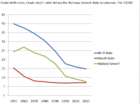
Natural Growth Rate in Lebanon throughout years
The balance of power has been slightly adjusted in the 1943 National Pact, an informal agreement struck at independence, in which positions of power were divided according to the 1932 demography. The Sunni elite was then accorded more power, merely Maronites continued to dominate the system. The sectarian balance was again adapted towards the Muslim side but simultaneously farther reinforced and legitimized. Shia Muslims (by now the 2nd largest sect) then gained additional representation in the state apparatus, and the obligatory Christian-Muslim representation in Parliament was downgraded from a vi:5 to a 1:one ratio. Christians of various denominations were then generally idea to constitute about 40% of the population, although often Muslim leaders would cite lower numbers, and some Christians would claim that they even so held a majority of the population.
18 recognized religious groups [edit]

An approximate of the area distribution of Lebanon's main religious groups
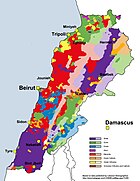
Distribution of Lebanon's religious groups according to 2009 municipal election information
The present Lebanese Constitution officially acknowledges 18 religious groups (see beneath). These have the correct to handle family law according to their ain courts and traditions, and they are the basic players in Lebanon's circuitous sectarian politics.
- Alawite
- Armenian Cosmic
- Armenian Orthodox
- Assyrian Church of the East
- Chaldean Catholic
- Copts
- Druze
- Greek Orthodox
- Isma'ili
- Jewish
- Latin Catholic
- Maronite Cosmic
- Melkite Greek Catholic
- Protestant
- Sunni
- Shia
- Syriac Catholic Church building
- Syriac Orthodox Church
Religious population statistics [edit]
Note: stateless Palestinians and Syrians are non included in the statistics below since they do not hold Lebanese citizenship. The numbers only include the present population of Lebanese republic, and not the Lebanese diaspora.
The 1932 census stated that Christians made upwardly 50% of the resident population. Maronites, largest amid the Christian denomination and then largely in control of the country appliance, accounted for 29% of the total resident population.
Total population of Lebanon was reported to be 1,411,000 in 1956.[12] The largest communities were Maronites (424,000), Sunni Muslims (286,000), Shiite Muslims(250,000), Greek Orthodox (149,000), Greek Catholics (91,000), Druzes (88,000), Armenian Orthodox (64,000), Armenian Catholics (15,000), Protestants (14,000), Jews (7,000), Syriac Catholics (6,000), Syriac Orthodox (5,000), Latins (4,000) and Nestorian Chaldeans (1,000).[12]
A 2010 report conducted by Statistics Lebanese republic, a Beirut-based inquiry firm, cited by the United States Department of State found that of Lebanon's population of approximately iv.3 one thousand thousand was estimated to exist:[13]
- 45% Christian (Maronite, Eastern Orthodox, Melkite Catholic, Protestant, other Christian denominations non-native to Lebanon like Armenian Orthodox, Armenian Catholic, Syriac Orthodox, Syriac Cosmic, Roman Cosmic, Chaldean, Assyrian, and Copt)
- 48% Islam (Shia and Sunni)
- 5.2% Druze (included within the Muslim group in the Lebanese Constitution.)
At that place is also a very pocket-sized number of other religious minorities such as, Baháʼís, Buddhists, Hindus and Mormons.[13]
In 2021, the CIA World Factbook specified that of those residing in Lebanese republic, 61.1% are Muslims (30.6% Sunni, thirty.v% Shia, with smaller percentages of Alawites and Ismailis), 33.7% are Christians (more often than not Maronites, Eastern Orthodox, Melkite Catholics, Protestant, Armenian Apostolic, Assyrian Church of the East, Syriac Orthodox, Chaldean Cosmic, Syrian Catholic), 5.two% are Druze, and in that location are "very small numbers of Jews, Baha'is, Buddhists, and Hindus".[fourteen]
Demography of 1932 [edit]
| Residents | Emigrants before xxx/08/1924 | Emigrants after xxx/08/1924 | |||
|---|---|---|---|---|---|
| paying taxes | does not pay | paying taxes | does not pay | ||
| Sunni | 178,100 | 2,653 | 9,840 | ane,089 | 3,623 |
| Shi'i | 155,035 | two,977 | four,543 | ane,770 | 2,220 |
| Druze | 53,334 | 2,067 | iii,205 | 1,183 | 2,295 |
| Maronite | 227,800 | 31,697 | 58,457 | xi,434 | 21,809 |
| Greek Catholic | 46,709 | 7,190 | 16,544 | i,855 | iv,038 |
| Greek Orthodox | 77,312 | 12,547 | 31,521 | 3,922 | nine,041 |
| Protestant | half-dozen,869 | 607 | 1,575 | 174 | 575 |
| Armenian Orthodox | 26,102 | 1 | lx | 191 | one,718 |
| Armenian Catholic | v,890 | 9 | 50 | 20 | 375 |
| Syriac Orthodox | two,723 | 6 | 34 | 3 | 54 |
| Syriac Catholic | 2,803 | 9 | 196 | 6 | 101 |
| Jews | 3,588 | six | 214 | 7 | 188 |
| Chaldean Orthodox | 190 | 0 | 0 | 0 | 0 |
| Chaldean Catholic | 548 | 0 | half-dozen | 0 | 19 |
| Miscellaneous | 6,393 | 212 | 758 | 59 | 234 |
| Total | 793,396 | 59,981 | 127,003 | 21,713 | 46,290 |
| Foreigners | 61.297 | ||||
| source[fifteen] | |||||
Muslims [edit]

A map of religious and ethnic communities of Syrian arab republic and Lebanon (1935)
According to the CIA World Factbook,[fourteen] in 2021 the Muslim population was estimated at lx% inside Lebanese territory and 20% of the over iv one thousand thousand[iv] [5] [vi] Lebanese diaspora population. In 2012 a more detailed breakdown of the size of each Muslim sect in Lebanon was made:
- The Shia Muslims are around 22.5%[16]–29%[17] [xviii] of the total population. The Speaker of Parliament is always a Shia Muslim, as it is the merely loftier postal service that Shias are eligible for.[19] [twenty] [21] [22] The Shias are largely concentrated in northern and western Beqaa, Southern Lebanon and in the southern suburbs of Beirut.[23]
- The Sunni Muslims constitute also about 25.5%[23]–29%[16] of the total population. Sunni notables traditionally held power in the Lebanese state together, and they are still the simply sect eligible for the post of Prime Minister[24] Sunnis are generally concentrated in westward Beirut, Tripoli, Sidon, Central and Western Beqaa, and Akkar in the north.[23]
- Other Muslim sects have a pocket-size presence, with the Isma'ilis and Alawites combined comprising less than 1% of the population and are included among Lebanese Shia Muslims.
Christians [edit]
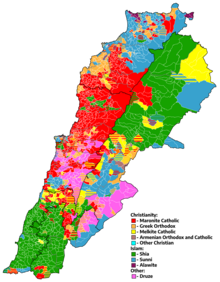
Religion map of Lebanese republic by municipality according to municipal elections data.

According to the CIA World Factbook,[14] in 2021, the Christian population in Lebanon was estimated at 35%. In 2012 a more detailed breakdown of the size of each Christian sect in Lebanese republic was made:
- The Maronites are the largest of the Christian groups about thirty%[16] of the population of Lebanon. They take had a long and continuous association with the Roman Cosmic Church, but accept their own patriarch, liturgy, and community. Traditionally they had skilful relations with the Western world, especially France[25] and the Vatican.[26] They traditionally dominated the Lebanese government. Their influence in later years has diminished, because of their relative decrease in numbers only also due to the Syrian occupation of Lebanon, which more often than not benefited Shia communities, and was resisted by most of the others. Today the Maronites are believed to compose about 26% of the population, scattered effectually the Lebanese countryside but with heavy concentrations on Mountain Lebanese republic and in Beirut (Greater Beirut).
- The second largest Christian group is the Eastern Orthodox that constitute at least ix%[sixteen] of the population. The church exists in many parts of the Arab world and Eastern Orthodox Christians have oft been noted for pan-Arab or pan-Syrian leanings; it has had less dealings with Western countries than the Maronites. The Eastern Orthodox Lebanese Christians accept a long and continuous association with Eastern Orthodox European countries like Greece, Cyprus, Russian federation, Ukraine, Bulgaria, Serbia and Romania. The Deputy Speaker of Parliament and the deputy Prime Minister are reserved for Eastern Orthodox Christians.
- The Melkite Catholics are thought to plant about 6%[16] of the population.
- The Protestants are thought to constitute about 1%[sixteen] of the population.
- The remaining Christian churches are thought to constitute another 5%[xvi] of the population (Roman Catholics, Armenian Apostolic, Armenian Catholic, Syriac Orthodox, Syriac Catholic, and Assyrians.)
Druze [edit]
The Druze constitute 5%[fourteen] of the population and tin be constitute primarily in the rural, mountainous areas of Mountain Lebanon and the Chouf District. Traditionally, the Druze tended to prefer Syria over the Westward, simply after the ceremonious war and the emergence of Hezbollah, the Druze hold a powerful negativity towards Syria, Iran, and Hezbollah, and at present the Druze strongly prefer to ally with the West. Fifty-fifty though the faith originally developed out of Ismaili Islam, most Druze do not identify as Muslims,[27] [28] [29] [thirty] [31] and they do not have the five pillars of Islam.[32]
Other religions [edit]
Other religions business relationship for only an estimated 0.iii% of the population mainly foreign temporary workers, according to the CIA Earth Factbook. There remains a very minor Jewish population, traditionally centered in Beirut. Information technology has been larger: most Jews left the country afterward the Lebanese Ceremonious War (1975–1990) as thousands of Lebanese did at that time.
Diaspora [edit]
Prominent Lebanese people and people of Lebanese descent. | |||||||||||||||||||||||||


Apart from the four and a half million citizens of Lebanon proper, there is a sizeable Lebanese diaspora. There are more than Lebanese people living outside of Lebanese republic (over four million[33] [34] [35]), than within (4.6 million citizens plus 1.5 million refugees). The majority of the diaspora population consists of Lebanese Christians; however, at that place are some who are Muslim. They trace their origin to several waves of Christian emigration, starting with the exodus that followed the 1860 Lebanese republic conflict in Ottoman Syria.
Under the current Lebanese nationality law, diaspora Lebanese do non have an automatic right of return to Lebanese republic. Due to varying degrees of assimilation and high degree of interethnic marriages, near diaspora Lebanese have not passed on the Arabic language to their children, while yet maintaining a Lebanese ethnic identity.
Many Lebanese families are economically and politically prominent in several Latin American countries (in 2007 Mexican Carlos Slim Helú, son of Lebanese immigrants, was determined to exist the wealthiest human in the World by Fortune Magazine), and make upwardly a substantial portion of the Lebanese American community in the United States. The largest Lebanese diaspora is located in Brazil, where well-nigh 6–7 million people have Lebanese descent (see Lebanese Brazilian). In Argentine republic, there is besides a large Lebanese diaspora of approximately 1.v million people having Lebanese descent. (meet Lebanese Argentine). In Canada, in that location is as well a large Lebanese diaspora of approximately 250,000-500,000 people having Lebanese descent. (come across Lebanese Canadians).
There are also sizable populations in West Africa, particularly Cote d'ivoire, Sierra Leone and Senegal.
The large size of Lebanese republic's diaspora may be partly explained past the historical and cultural tradition of seafaring and traveling, which stretches dorsum to Lebanon's ancient Phoenician origins and its office as a "gateway" of relations between Europe and the Middle Due east. It has been commonplace for Lebanese citizens to emigrate in search of economic prosperity. Furthermore, on several occasions in the final two centuries the Lebanese population has endured periods of ethnic cleansing and deportation (for example, 1840–threescore and 1975–xc). These factors have contributed to the geographical mobility of the Lebanese people.
While nether Syrian occupation, Beirut passed legislation which prevented second-generation Lebanese of the diaspora from automatically obtaining Lebanese citizenship. This has reinforced the émigré status of many diaspora Lebanese. There is currently a campaign by those Lebanese of the diaspora who already have Lebanese citizenship to achieve the vote from away, which has been successfully passed in the Lebanese parliament and will exist effective equally of 2013 which is the next parliamentary elections. If suffrage was to be extended to these 1.2[ citation needed ] million Lebanese émigré citizens, it would have a pregnant political event, since equally many as 80% of them are believed to be Christian.[ citation needed ]
Lebanese Ceremonious War refugees and displaced persons [edit]
With no official figures available, information technology is estimated that 600,000–900,000 persons fled the state during the Lebanese Ceremonious War (1975–90). Although some have since returned, this permanently disturbed Lebanese population growth and profoundly complicated demographic statistics.
Another effect of the war was a large number of internally displaced persons. This specially affected the southern Shia community, as Israeli invasion of southern Lebanon in 1978, 1982, and 1996 prompted waves of mass emigration, in addition to the continual strain of occupation and fighting between State of israel and Hezbollah (mainly 1982 to 2000).
Many Shias from Southern Lebanon resettled in the suburbs due south of Beirut. After the war, the pace of Christian emigration accelerated, every bit many Christians felt discriminated against in a Lebanon under increasingly oppressive Syrian occupation.
According to a UNDP report, as much as x% of the Lebanese had a disability in 1990.[36] Other studies accept pointed to the fact that this portion of society is highly marginalized due to the lack of educational and governmental support of their advancement.[36]
Languages [edit]
Arabic is the official language of the country. Lebanese Arabic is by and large spoken in non-official contexts. French and English are taught in many schools from a immature age. Amongst the Armenian ethnic minority in Lebanon, the Armenian language is taught and spoken within the Armenian community.
CIA World Factbook demographic statistics [edit]

The following demographic statistics are from the CIA World Factbook, unless otherwise indicated.
- Population:
- Total population: 6,100,075 (July 2018 est.)
- Lebanese nationals: iv,680,212 (July 2018 est.)
- Syrian refugees: 944,613 (April 2019 est.) registered at the UNHCR (downwardly from 1,077,000 in June 2014)
- Palestinian refugees: 175,555 (2018 est.)
- Iraqi refugees: 5,695 (2017 est.)
Historic period structure:
- 0–14 years: 23.32% (male person 728,025/female person 694,453) 15–24 years: 16.04% (male 500,592/female person 477,784) 25–54 years: 45.27% (male i,398,087/female person 1,363,386) 55–64 years: 8.34% (male 241,206/female 267,747) 65 years and over: 7.03% (male 185,780/female 243,015) (2018 est.)
- Median age:
- Total: 31.3 years
- Male person: 30.7 years
- Female: 31.nine years (2018 est.)
- Population growth charge per unit:
- ane.04% (2005 est.)
- 0.96% (2011 est.)
- −3.13% (2018 est.)
- Cyberspace migration rate:
- −4.43 migrant(s)/1,000 population (2011 est.)
- −40.3 migrant(due south)/1,000 population (2018 est.)
- Sex ratio:
- at nascency: 1.05 male person(s)/female
- under fifteen years: 1.04 male(s)/female
- 15–64 years: 0.92 male person(south)/female
- 65 years and over: 0.83 male person(s)/female
- full population: 0.94 male(s)/female person (2005 est.)
- Life expectancy at nascency:
- total population: 77.9 years
- male: 76.vi years
- female: 79.3 years (2018 est.)
Vital statistics [edit]
UN estimates [edit]
| Period[37] | Live births per yr | Deaths per year | Natural change per year | CBR1 | CDR1 | NC1 | TFRi | IMR1 |
|---|---|---|---|---|---|---|---|---|
| 1950–1955 | 61,000 | 24,000 | 38,000 | 39.9 | xv.4 | 24.four | 5.74 | xc.0 |
| 1955–1960 | seventy,000 | 23,000 | 47,000 | 39.3 | 12.7 | 26.6 | five.72 | 72.8 |
| 1960–1965 | 77,000 | 22,000 | 55,000 | 37.6 | 10.seven | 26.nine | v.69 | 61.i |
| 1965–1970 | 81,000 | 21,000 | 59,000 | 34.5 | 9.ii | 25.iii | 5.34 | 53.4 |
| 1970–1975 | 83,000 | 21,000 | 62,000 | 31.9 | 8.1 | 23.viii | iv.78 | 47.0 |
| 1975–1980 | 85 000 | 22 000 | 63 000 | 30.v | seven.8 | 22.7 | 4.31 | 44.ii |
| 1980–1985 | 84,000 | 21,000 | 62,000 | 29.5 | 7.six | 21.nine | three.xc | 40.half-dozen |
| 1985–1990 | 78,000 | 21,000 | 57,000 | 26.vii | 7.3 | 19.4 | iii.31 | 36.viii |
| 1990–1995 | 80,000 | 23,000 | 57,000 | 24.eight | seven.1 | 17.eight | 3.00 | 31.4 |
| 1995–2000 | 81,000 | 26,000 | 56,000 | 22.half-dozen | 7.ane | 15.5 | 2.lxx | 28.1 |
| 2000–2005 | 69,000 | 27,000 | 42,000 | 17.seven | vi.ix | 10.eight | 2.09 | 25.6 |
| 2005–2010 | 66,000 | 28,000 | 38,000 | 15.9 | half dozen.9 | 9.1 | one.86 | 22.vii |
| 2010–2015 | 63,000 | 29,000 | 34,000 | xiv.8 | 7.one | seven.7 | 1.81 | 18.7 |
| 1 CBR = crude birth charge per unit (per 1000); CDR = rough death charge per unit (per 1000); NC = natural change (per 1000); TFR = total fertility rate (number of children per woman); IMR = babe mortality rate per 1000 births | ||||||||
Registered births and deaths [edit]
| [38] [39] | Boilerplate population | Live births | Deaths | Natural change | Rough birth rate (per m) | Crude decease rate (per 1000) | Natural modify (per k) | Total fertility rate (TFR) |
|---|---|---|---|---|---|---|---|---|
| 1990 | 70,903 | 13,263 | 57,640 | |||||
| 1991 | 82,742 | 15,773 | 66,969 | |||||
| 1992 | 94,607 | eighteen,042 | 76,565 | |||||
| 1993 | ninety,947 | 24,223 | 66,724 | |||||
| 1994 | ninety,712 | 18,421 | 72,291 | |||||
| 1995 | 91,196 | xix,230 | 71,966 | |||||
| 1996 | 86,997 | 19,962 | 67,035 | |||||
| 1997 | 85,018 | 19,884 | 65,134 | |||||
| 1998 | 84,250 | 20,097 | 64,153 | |||||
| 1999 | 85,955 | 19,813 | 66,142 | |||||
| 2000 | 87,795 | nineteen,435 | 68,360 | |||||
| 2001 | 83,693 | 17,568 | 66,125 | |||||
| 2002 | 76,405 | 17,294 | 59,111 | |||||
| 2003 | 71,702 | 17,187 | 54,515 | |||||
| 2004 | 73,900 | 17,774 | 56,126 | ane.75 | ||||
| 2005 | 73,973 | 18,012 | 55,961 | |||||
| 2006 | 72,790 | 18,787 | 54,003 | |||||
| 2007 | iii,759,137 | eighty,896 | 21,092 | 59,804 | 21.five | 5.6 | 15.9 | |
| 2008 | 84,823 | 21,048 | 63,775 | |||||
| 2009 | 90,388 | 22,260 | 68,128 | |||||
| 2010 | 95,218 | 22,926 | 72,292 | |||||
| 2011 | 98,569 | 26,070 | 72,499 | 26.1 | vi.ix | nineteen.2 | 1.60 | |
| 2012 | 94,842 | 23,452 | 71,390 | |||||
| 2013 | 95,246 | 24,013 | 71,233 | |||||
| 2014 | 104,872 | 27,020 | 77,852 | |||||
| 2015 | 109,724 | 25,275 | 84,449 | |||||
| 2016 | 114,025 | 24,617 | 89,408 | |||||
| 2017 | 123,859 | 25,847 | 98,012 | |||||
| 2018 | 128,687* | 25,096 | 103,591 | |||||
| 2019 | 24,949 | |||||||
| 2020 | 28,072 | |||||||
| 2021 | 36,950 |
- Births for 2018 includes Lebanese births (69,646) and not-Lebanese (59,041)
Life expectancy [edit]
| Menstruation[forty] | Life expectancy in Years | Flow | Life expectancy in Years |
|---|---|---|---|
| 1950–1955 | sixty.5 | 1985–1990 | 69.6 |
| 1955–1960 | 62.iv | 1990–1995 | 71.0 |
| 1960–1965 | 64.0 | 1995–2000 | 73.2 |
| 1965–1970 | 65.iv | 2000–2005 | 75.v |
| 1970–1975 | 66.7 | 2005–2010 | 77.7 |
| 1975–1980 | 67.6 | 2010–2015 | 78.nine |
| 1980–1985 | 68.4 |
Immigrants and ethnic groups [edit]
There are substantial numbers of immigrants from other Arab countries (mainly Palestine, Syria, Iraq and Egypt) and non-Arab-speaking Muslim countries. As well, recent years have seen an influx of people from Ethiopia[41] and South East Asian countries such as Indonesia, the Philippines, Malaysia, Sri Lanka,[42] likewise every bit smaller numbers of other immigrant minorities, Colombians and Brazilians (of Lebanese descent themselves). Most of these are employed as guest workers in the same mode every bit Syrians and Palestinians, and entered the country to search for employment in the postal service-war reconstruction of Lebanon. Apart from the Palestinians, there are approximately 180,000 stateless persons in Lebanon.
Summary including non-Lebanese.
Other (4.six%)
Armenians, Jews and Iranians [edit]
Lebanese Armenians, Jews and Iranians form more distinct indigenous minorities, all of them in possession of a separate languages (Armenian, Hebrew, Persian) and a national abode surface area (Armenia, Israel, Islamic republic of iran) outside of Lebanon. However, they combined full five% of the population.
French and Italians [edit]
During the French Mandate of Lebanese republic, at that place was a fairly large French minority and a tiny Italian minority. Nearly of the French and Italian settlers left after Lebanese independence in 1943 and but 22,000 French Lebanese and 4,300 Italian Lebanese continue to live in Lebanese republic. The most important legacy of the French Mandate is the frequent utilize and knowledge of the French linguistic communication by most of the educated Lebanese people, and Beirut is all the same known every bit the "Paris of the Heart Due east".
Palestinians [edit]
Effectually 175,555 Palestinian refugees were registered in Lebanese republic with the UNRWA in 2014, who are refugees or descendants of refugees from the 1948 Arab–Israeli War. Some 53% live in 12 Palestine refugee camps, who "suffer from serious problems" such equally poverty and overcrowding.[43] Some of these may take emigrated during the civil war, merely at that place are no reliable figures available. In that location are also a number of Palestinians who are not registered equally UNRWA refugees, because they left earlier than 1948 or were not in need of fabric assist. The exact number of Palestinians remain a discipline of slap-up dispute and the Lebanese government will non provide an estimate. A figure of 400,000 Palestinian refugees would hateful that Palestinians found less than 7% of the resident population of Lebanon.
Palestinians living in Lebanese republic are considered foreigners and are nether the aforementioned restrictions on employment applied to other foreigners. Prior to 2010, they were under even more restrictive employment rules which permitted, other than work for the U.N., just the near menial employment. They are not allowed to attend public schools, own property, or make an enforceable will.[44] Palestinian refugees, who constitute nearly 6.6% of the country's population, have long been denied basic rights in Lebanese republic. They are non immune to nourish public schools, own property or laissez passer on inheritances, measures Lebanon says it has adopted to preserve their right to return to their property in what constitutes State of israel at present.
Their presence is controversial, and resisted by large segments of the Christian population, who argue that the primarily Sunni Muslim Palestinians dilute Christian numbers. Many Shia Muslims too await unfavorably upon the Palestinian presence since the refugee camps have tended to be concentrated in their home areas. The Lebanese Sunnis, all the same, would be happy to see these Palestinians given the Lebanese nationality, thus increasing the Lebanese Sunni population by well over 10% and tipping the fragile balloter balance much in favor of the Sunnis. Tardily prime minister Rafiq Hariri —himself a Sunni— had hinted on more than one occasion on the inevitability of granting these refugees Lebanese citizenship. Thus far the refugees lack Lebanese citizenship as well as many rights enjoyed past the rest of the population, and are confined to severely overcrowded refugee camps, in which construction rights are severely constricted.
Palestinians may not piece of work in a large number of professions, such every bit lawyers and doctors. However, later on negotiations between Lebanese authorities and ministers from the Palestinian National Potency some professions for Palestinians were immune (such every bit taxi commuter and construction worker). The material situation of the Palestinian refugees in Lebanon is hard, and they are believed to found the poorest community in Lebanese republic, also as the poorest Palestinian community with the possible exception of Gaza Strip refugees. Their primary sources of income are UNRWA aid and menial labor sought in contest with Syrian guest workers.
The Palestinians are almost totally Sunni Muslim, though at some point Christians counted as high as 40% with Muslims at 60%. The numbers of Palestinian Christians has diminished in later years, as many have managed to get out Lebanon. During the Lebanese Civil State of war, Palestinian Christians sided with the rest of the Palestinian community, instead of allying with Lebanese Eastern Orthodox or other Christian communities.
60,000 Palestinians have received Lebanese citizenship, including almost Christian Palestinians.[45] [46]
Syrians [edit]
In 1976, the so Syrian president Hafez al-Assad sent troops into Lebanon to fight PLO forces on behalf of Christian militias. This led to escalated fighting until a cease-fire agreement subsequently that year that allowed for the stationing of Syrian troops inside Lebanon. The Syrian presence in Lebanese republic quickly inverse sides; before long after they entered Lebanon they had flip-flopped and began to fight the Christian nationalists in Lebanon they allegedly entered the country to protect. The Kateab Party and the Lebanese Forces under Bachir Gemayel strongly resisted the Syrians in Lebanese republic. In 1989, 40,000 Syrian troops remained in central and eastern Lebanon under the supervision of the Syrian government. Although, the Taif Accordance, established in the aforementioned yr, called for the removal of Syrian troops and transfer of arms to the Lebanese army, the Syrian Army remained in Lebanon until the Lebanese Cedar Revolution in 2005 ended the Syrian occupation of Lebanon.
In 1994, the Lebanese government under the force per unit area of the Syrian regime, gave Lebanese passports to thousands of Syrians.[47]
There are nearly one.08 meg registered[48] Syrian refugees in Lebanese republic[49]but is estimated that Lebanon hosts 1.5 million.[50]
Assyrians [edit]
In that location are an estimated xl,000 to eighty,000 Iraqi Assyrian refugees in Lebanon. The vast bulk of them are undocumented, with a big number having been deported or put in prison.[51] They vest to various denominations, including the Assyrian Church of the East, Chaldean Cosmic Church building, and Syriac Catholic Church.
Iraqis [edit]
Due to the U.s.-led invasion of Iraq, Lebanon received a mass influx of Iraqi refugees numbering at around 100,000. The vast majority of them are undocumented, with a big number having been deported or put in prison.[51]
Kurds [edit]
At that place are an estimated 60,000 to 100,000 Kurdish refugees from Turkey and Syrian arab republic within Lebanese territory. Many of them are undocumented. As of 2012, around forty% of all Kurds in Lebanon do non have Lebanese citizenship.[52]
Turks [edit]
The Turkish people began to migrate to Lebanon one time the Ottoman sultan Selim I conquered the region in 1516. Turks were encouraged to stay in Lebanon by being rewarded with land and money.[53] Today the Turkish minority numbers approximately 80,000.[54] Moreover, since the Syrian Civil War, approximately 125,000 to 150,000 Syrian Turkmen refugees arrived in Lebanon, and hence they now outnumber the long established Turkish minority who settled since the Ottoman era.[55] [56]
Circassians [edit]
The Circassians migrated to the Ottoman Empire including Lebanese republic and neighboring countries in the 18th and 19th century. Nonetheless, they are mostly located in Akkar Governorate, in which they have come to Berkail since 1754. Today the Circassian minority numbers approximately 100,000.[57] [58]
See as well [edit]
- Demographics of the Heart E
Notes [edit]
References [edit]
- ^ "CIA World Factbook - Lebanon". 23 Nov 2021.
- ^ "International Religious Liberty Report – Lebanon". 2001 Report on International Religious Freedom. U.s. Department of State. 26 October 2001. Retrieved 8 January 2009.
- ^ "Grégoire Haddad et la démographie libanaise". Fifty'Orient-Le Jour. 31 December 2015. Retrieved 2016-04-12 .
- ^ a b International Migration and the Lebanese Diaspora. IFPO Publications de 50'Institut français du Proche-Orient. Co-éditions. Presses de 50'Ifpo. 3 October 2019. pp. 42–43. ISBN9782351595497.
{{cite book}}: CS1 maint: url-status (link) - ^ a b "Methods of Finding Population Statistics of Lebanese Migration Throughout the World". Khayrallah Center for Lebanese Diaspora Studies News at Northward Carolina Country University. 2015. Archived from the original on 2016-ten-24.
- ^ a b "Annuario Pontificio- The Eastern Cosmic Churches 2017" (PDF). Annuario Pontificio. Archived (PDF) from the original on 2018-10-24.
- ^ Lebanese Living in UAE Fearfulness Displacement Archived 2014-x-sixteen at the Wayback Motorcar Al-Monitor, accessed December 2, 2013
- ^ "Sectarian and Clan Consciousness – Lebanon". U.S. Library of Congress. Land Studies. Retrieved 2009-01-08 .
- ^ Maroon, Habib (31 March 2013). "A geneticist with a unifying bulletin". Nature. doi:x.1038/nmiddleeast.2013.46.
- ^ "Identity of the Maronite Church building - Introduction". Bkerkelb.org. Archived from the original on 2011-10-07.
- ^ "Identity of the Maronite Church - A Syriac Antiochene Church building with a Special Lit. Heritage". Bkerkelb.org. Archived from the original on 2011-ten-07.
- ^ a b Jacob M. Landau (March 1961). "Elections in Lebanon" (PDF). The Western Political Quarterly. 14 (i): 121. JSTOR 443935.
- ^ a b "2012 Study on International Religious Liberty - Lebanon". Us Department of Land. 20 May 2013. Retrieved 9 January 2013.
- ^ a b c d "CIA Globe Factbook (2021) - Lebanon". www.cia.gov. Centra Intelligence Agency. Retrieved 25 May 2021.
- ^ Rania Maktabi, The Lebanese Census of 1932 Revisited. Who Are the Lebanese?, British Periodical of Middle Eastern Studies, Vol. 26, No. ii (November., 1999), pp. 219-241, besides at [one], at [2] at [3] and at [iv]
- ^ a b c d e f g "Statistics Lebanon Beirut-based inquiry house".
- ^ "International Religious Freedom Report 2008 – Lebanese republic". 2008 Written report on International Religious Freedom. US Department of State. September 19, 2008. Retrieved 2009-01-08 .
- ^ "Countries with more than 100,000 Shia Muslims" (PDF). Pew Research Middle. Oct 2009. Archived from the original (PDF) on 9 May 2010. Retrieved 21 September 2010.
- ^ "Lebanon-Religious Sects". GlobalSecurity.org. Retrieved 11 August 2010.
- ^ Hanin Ghaddar (25 April 2010). "March for secularism; religious laws are archaic". At present Lebanese republic. Retrieved 11 August 2010.
- ^ "Fadlallah Charges Every Sect in Lebanon Except his Own Wants to Boss the Country". Naharnet. Retrieved xi Baronial 2010.
- ^ George J. Hajjar. "Aspects of Christian-Muslim Relations in Gimmicky Lebanese republic". hartsem.edu. Hartford, CT, United states of america: Hartford Seminary. Archived from the original on 2012-08-27. Retrieved 4 August 2012.
- ^ a b c "Minority Rights Grouping International : Lebanon : Lebanon Overview". Minorityrights.org.
- ^ "Lebanese republic". state.gov. Washington, DC, U.s.a.: United States Department of State. Retrieved iv August 2012.
- ^ "French Mandate". Encyclopædia Britannica . Retrieved 6 December 2015.
- ^ Fr. Samir: Benedict Xvi'south backbone carries the Churches of the Heart Eastward and the Arab Spring
- ^ Pintak, Lawrence (2019). America & Islam: Soundbites, Suicide Bombs and the Road to Donald Trump. Bloomsbury Publishing. p. 86. ISBN9781788315593.
- ^ Jonas, Margaret (2011). The Templar Spirit: The Esoteric Inspiration, Rituals and Beliefs of the Knights Templar. Temple Order Publishing. p. 83. ISBN9781906999254.
[Druze] often they are not regarded every bit existence Muslim at all, nor exercise all the Druze consider themselves as Muslim
- ^ "Are the Druze People Arabs or Muslims? Deciphering Who They Are". Arab America. Arab America. eight Baronial 2018. Retrieved thirteen April 2020.
- ^ J. Stewart, Dona (2008). The Center Eastward Today: Political, Geographical and Cultural Perspectives. Routledge. p. 33. ISBN9781135980795.
Most Druze do not consider themselves Muslim. Historically they faced much persecution and go on their religious beliefs secrets.
- ^ Yazbeck Haddad, Yvonne (2014). The Oxford Handbook of American Islam. Oxford University Press. p. 142. ISBN9780199862634.
While they appear parallel to those of normative Islam, in the Druze faith they are different in pregnant and estimation. The faith is consider distinct from the Ismaili every bit well as from other Muslims belief and practice... Most Druze consider themselves fully alloyed in American social club and do not necessarily identify equally Muslims..
- ^ De McLaurin, Ronald (1979). The Political Role of Minority Groups in the Middle East. Michigan University Printing. p. 114. ISBN9780030525964.
Theologically, i would have to conclude that the Druze are non Muslims. They do not accept the five pillars of Islam. In identify of these principles the Druze have instituted the seven precepts noted above..
- ^ International Migration and the Lebanese Diaspora. IFPO Publications de l'Institut français du Proche-Orient. Co-éditions. Presses de l'Ifpo. 3 October 2019. pp. 42–43. ISBN9782351595497.
{{cite volume}}: CS1 maint: url-status (link) - ^ "Methods of Finding Population Statistics of Lebanese Migration Throughout the Globe". Khayrallah Center for Lebanese Diaspora Studies News at North Carolina State Academy. 2015. Archived from the original on 2016-ten-24.
- ^ "Annuario Pontificio- The Eastern Catholic Churches 2017" (PDF). Annuario Pontificio. Archived (PDF) from the original on 2018-10-24.
- ^ a b Lebanese republic: Disabled remain marginalized, study finds, IRIN. Accessed August half-dozen, 2009.
- ^ "World Population Prospects: The 2010 Revision". esa.un.org. Archived from the original on 6 May 2011.
- ^ "Vital Information Observatory Statistics". www.moph.gov.lb.
- ^ "The Lebanese Demographic Reality" (PDF). Lebanese Data Center Lebanon . Retrieved xviii June 2021.
- ^ "Globe Population Prospects - Population Sectionalisation - United nations". esa.un.org . Retrieved 2018-08-26 .
- ^ "IOM Steps Up Evacuation of Stranded Migrants from Lebanon". International Organisation for Migration. July 26, 2006. Archived from the original on 2006-11-01. Retrieved 2009-01-08 .
- ^ "CBC News In Depth: Middle Due east in Crisis – Canada and Lebanon, a special necktie". CBC News. 1 Baronial 2006. Archived from the original on 2006-07-21. Retrieved 8 Jan 2009.
- ^ "Where Nosotros Work: Lebanese republic". UNRWA. 1 July 2014. Retrieved 6 Dec 2015.
- ^ Zero Bakri (17 August 2010). "Lebanon Gives Palestinians New Work Rights". The New York Times . Retrieved 17 August 2010.
- ^ Julie Peteet (1996). "From Refugees to Minority: Palestinians in Post-War Lebanon". prrn.mcgill.ca. Retrieved 6 Dec 2015.
- ^ "Lebanon: Information on the treatment of Palestinian Christians by the authorities". Unhcr.org. one August 1996. Retrieved 6 December 2015.
- ^ "Citizenship requirements and procedures for an private who was built-in in Lebanon to parents with Syrian citizenship, has a permanent residency permit, and whose spouse was granted Lebanese citizenship by Decree (2012-November 2013)". Refworld. United Nations High Commissioner for Refugees.
- ^ "UNHCR - Lebanese republic". unhcr.org.
- ^ Un High Commissioner for Refugees (UNHCR) (31 October 2015). "Syrian arab republic Regional Refugee Response - Lebanon". UNHCR Syria Regional Refugee Response . Retrieved half-dozen December 2015.
- ^ "The Plight of Syrian Refugees – PRIO Blogs". blogs.prio.org . Retrieved 2022-01-11 .
- ^ a b Murphy, Maureen Clare (2007-04-09). "Invisible lives: Iraqis in Lebanon". The Electronic Intifada . Retrieved 2021-10-30 .
- ^ Brooke Anderson (nine February 2012). "Kurds in Lebanese republic endure poverty, grapple with assimilation". Ekurd Daily. Retrieved thirteen Nov 2014.
- ^ Orhan, Oytun (2010), The Forgotten Turks: Turkmens of Lebanon (PDF), ORSAM, p. 7, archived from the original (PDF) on 2016-03-03
- ^ Al-Akhbar. "Lebanese Turks Seek Political and Social Recognition". Archived from the original on 2018-06-20. Retrieved 2012-03-02 .
- ^ Ahmed, Yusra (2015), Syrian Turkmen refugees face double suffering in Lebanon, Zaman Al Wasl, retrieved 11 Oct 2016
- ^ Syrian Observer (2015). "Syria'southward Turkmen Refugees Face up Roughshod Reality in Lebanon". Retrieved ten October 2016.
- ^ "الشركس في لبنان: تمسّك بالأصول رغم صعوبة اللغة والتواصل". nidaalwatan.com (in Arabic). 3 Baronial 2019.
- ^ "Circassians from Lebanon visited Abkhazia for the first time". apsnypress.info. 10 May 2017.

How Has The Makeup Of The Population Changed Since 1943,
Source: https://en.wikipedia.org/wiki/Demographics_of_Lebanon
Posted by: minkgessarcidigh.blogspot.com
0 Response to "How Has The Makeup Of The Population Changed Since 1943"
Post a Comment